Now developers can get phone numbers connected to VoxImplant in more than 40 countries, including United States, United Kingdom, Russia, Argentina, Australia, Austria etc.
Mozilla recently released Firefox 34 and there were some changes in WebRTC stack that weren't compatible with our Web SDK. We have fixed most of them, p2p video calling will be fixed on Monday.
Voximplant now includes a native Cartesia module for streaming, low-latency text-to-speech (TTS). You can use a single VoxEngine API to synthesize speech in real time, connect it to any call (PSTN, SIP, WebRTC, WhatsApp) and control playback from a Large Language Model (LLM) or other source, all inside VoxEngine.
Today Ultravox announced they are directly integrating Voximplant into their platform to provide SIP capabilities. The integration builds on Voximplant’s deep telephony and Voice AI tooling
Voximplant now includes a native Cartesia Line / Agents connector that connects any Voximplant call to a Cartesia Line voice agent for real-time, speech-to-speech conversations—over PSTN, SIP, WebRTC, or WhatsApp Business Calling—without building custom media gateways or WebSocket streaming infrastructure.
New integrations for Voice AI have arrived: Google's Gemini 2.0 Flash model, featuring seamless voice-to-voice conversation capabilities and ElevenLabs low-latency streaming speech synthesis are now available for Voximplant developers
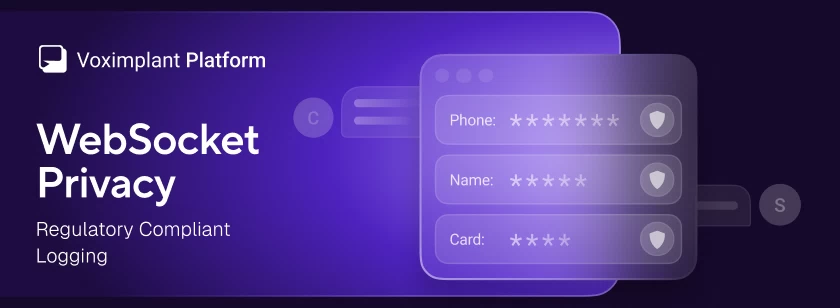
Voximplant has added a WebSocket privacy option that redacts message payloads from logs across all WebSocket-based services – Voice AI connectors and external speech system – and speech control modules
Learn how a Voice AI Orchestration Platform connects LLMs, STT/TTS, turn‑taking, and telephony (PSTN, SIP, WebRTC) to build reliable real‑time voice agents. See benefits, architecture, and how Voximplant helps.




 2015-01-19
 219343