The relevance of remote business has grown rapidly due to changing conditions in world markets. Several companies are facing challenges because they are not set up for their employees to transition to remote work but situations like these call for immediate measures.
UC (or Unified Communications) are a combination of real-time communication technologies, such as chats and document collaborations, integrated with offline communication methods that do not require the presence of a person (e-mail, voicemail, SMS, fax).
We've started with audio, then we've added video calls and now it's time to let our developers use instant messaging and presence - two very important features of UC stack.
Agentic VoiceDSP handles turn-taking for voice agents on your own STT, LLM and TTS: pauses, interruptions, silence and noisy lines, right inside Voximplant.
Voximplant now includes a native Deepgram module that connects any Voximplant call to Deepgram’s Voice Agent API for real-time, speech‑to‑speech conversations. You can stream audio from phone numbers, SIP trunks, WhatsApp, or WebRTC into Deepgram’s unified agent environment—combining STT, LLM reasoning, and TTS—and play responses via Voximplant’s serverless runtime with minimal latency.
Connect any OpenAI-compatible text LLM to your voice AI pipeline in VoxEngine via Chat Completions or Responses API. Set baseUrl to any provider or your own deployment, including EU endpoints for data residency
Use Realtime API in VoxEngine to build speech-to-speech voice AI with data residency control. Set baseUrl to any OpenAI Realtime-compatible endpoint, including Azure EU deployments, and control where call audio is processed
Voximplant now includes a native MCP Client for VoxEngine, giving developers direct connectivity to any MCP server and full control over every tool call
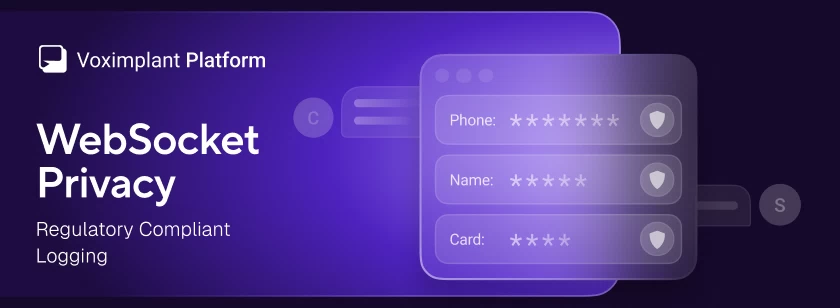
Voximplant has added a WebSocket privacy option that redacts message payloads from logs across all WebSocket-based services – Voice AI connectors and external speech system – and speech control modules




 2020-03-19
 179874