




Mobile SDKs: legacy API removal
As of October 1, 2019, we will release new versions of mobile SDKs to remove legacy APIs.
 2019-09-02
 203053
As of October 1, 2019, we will release new versions of mobile SDKs to remove legacy APIs.
2019-09-02203053
The new version of our mobile SDK uses WebRTC engine for audio/video processing and supports all features available for WebSDK.
2015-03-25139227
VoxImplant developers can easily embed all functionality VoxImplant offers into their native Android applications.
2014-05-04143496
Adding real-time communication functionality into your iOS mobile app has never been easier.
2013-10-27142634
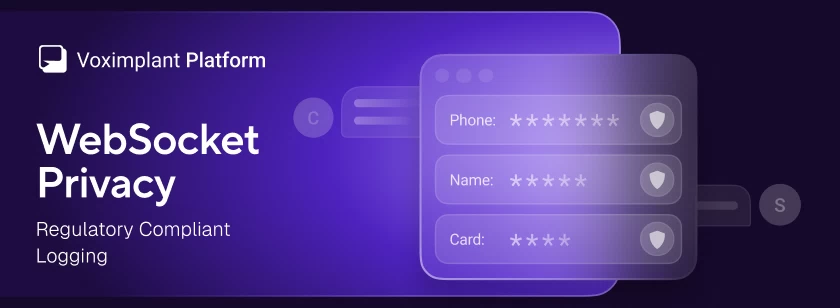
Voximplant has added a WebSocket privacy option that redacts message payloads from logs across all WebSocket-based services – Voice AI connectors and external speech system – and speech control modules
2026-04-235535
A practical guide to running a compliant voice AI stack on Voximplant: EU data residency, compliance documentation, and what to verify at each layer — telephony, LLM, STT, and TTS
2026-08-064340
Connect any OpenAI-compatible text LLM to your voice AI pipeline in VoxEngine via Chat Completions or Responses API. Set baseUrl to any provider or your own deployment, including EU endpoints for data residency
2026-07-225914
Voximplant now includes a native Deepgram module that connects any Voximplant call to Deepgram’s Voice Agent API for real-time, speech‑to‑speech conversations. You can stream audio from phone numbers, SIP trunks, WhatsApp, or WebRTC into Deepgram’s unified agent environment—combining STT, LLM reasoning, and TTS—and play responses via Voximplant’s serverless runtime with minimal latency.
2025-12-1735021
Voximplant now includes a native MCP Client for VoxEngine, giving developers direct connectivity to any MCP server and full control over every tool call
2026-06-035306
Agentic VoiceDSP handles turn-taking for voice agents on your own STT, LLM and TTS: pauses, interruptions, silence and noisy lines, right inside Voximplant.
2026-10-05186
Voximplant now includes a native Cartesia Line / Agents connector that connects any Voximplant call to a Cartesia Line voice agent for real-time, speech-to-speech conversations—over PSTN, SIP, WebRTC, or WhatsApp Business Calling—without building custom media gateways or WebSocket streaming infrastructure.
2026-02-1111780
Use Realtime API in VoxEngine to build speech-to-speech voice AI with data residency control. Set baseUrl to any OpenAI Realtime-compatible endpoint, including Azure EU deployments, and control where call audio is processed
2026-07-294407