Computer telephony integration (CTI) connectors deliver increased contact center efficiency and better customer experiences, but their cost and complexity has limited adoption to large enterprises.
Our experts have identified 9 important customer service trends that you should know about if you want to keep up with competitors and improve the overall customer experience. Let's take a look at how customer service is changing along with technology in 2020.
As we enter a holiday season still in the midst of the pandemic, consumer reliance on ecommerce will only increase. Retail experts predict that ecommerce retailers could see a boost in sales of 25-35% during this holiday season.
When it comes to analyzing contact center effectiveness, managers struggle to choose the most relevant metrics. Here, we review KPIs that measure customer experience and boost contact center performance.
Serverless architectures make it easy to deploy apps in the cloud. Developers can run the app code without the hassle of deploying and maintaining servers. Cloud providers manage servers for you.
Communications Platforms as a Service (CPaaS) provide tools and services developers can use to add real time voice and video communications to their applications.
Traditionally, companies have used a direct inward dialing service to route calls through an on-premises PBX directly to the internal phone number of an employee. It allows the company to use one physical trunk line to connect multiple employees.
With push notifications, you can deliver to customers targeted in-app messages such as exclusive offers, product shipping information or payment reminders.
How many times a day do you talk to a computer? We’re not referring to the exasperated exclamation you direct at your laptop when it overheats and crashes. We want you to think about the moments you speak to a device and it actually listens.
Voximplant now includes a native Cartesia module for streaming, low-latency text-to-speech (TTS). You can use a single VoxEngine API to synthesize speech in real time, connect it to any call (PSTN, SIP, WebRTC, WhatsApp) and control playback from a Large Language Model (LLM) or other source, all inside VoxEngine.
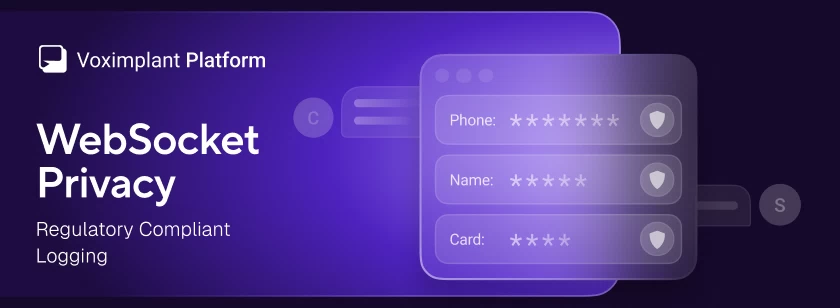
Voximplant has added a WebSocket privacy option that redacts message payloads from logs across all WebSocket-based services – Voice AI connectors and external speech system – and speech control modules
Voximplant now supports Inworld's Realtime API, so you can bring Inworld's expressive, conversation-aware agents into real phone calls, SIP, and WhatsApp without custom media infrastructure
Voximplant now includes a native Deepgram module that connects any Voximplant call to Deepgram’s Voice Agent API for real-time, speech‑to‑speech conversations. You can stream audio from phone numbers, SIP trunks, WhatsApp, or WebRTC into Deepgram’s unified agent environment—combining STT, LLM reasoning, and TTS—and play responses via Voximplant’s serverless runtime with minimal latency.
Voximplant now includes a native MCP Client for VoxEngine, giving developers direct connectivity to any MCP server and full control over every tool call
Voximplant now includes a native Cartesia Line / Agents connector that connects any Voximplant call to a Cartesia Line voice agent for real-time, speech-to-speech conversations—over PSTN, SIP, WebRTC, or WhatsApp Business Calling—without building custom media gateways or WebSocket streaming infrastructure.




 2020-10-27
 154960