Companies conduct phone surveys both to identify market trends and improve the customer experience. In this case, voice bots are an appropriate option since their implementation takes less time and frees up operators for more complex tasks
Each online shop is willing to increase its conversions. How to achieve this? A shop may have well-organized business processes, from engaging advertising content to the large coverage of well-tuned targeting ads.
The Voximplant Kit now includes a new scenario autosave feature. Now you don’t have to worry that some changes you made to the scenario might be lost if you forgot to save these changes.
This update brings a new user interface crafted by our UX experts, along with new tools and features for even smarter call processing automation. Let’s walk through the major changes.
Voximplant Kit will soon have a new and improved IVR block with faster and more accurate speech synthesis and recognition. Learn more about the improvements.
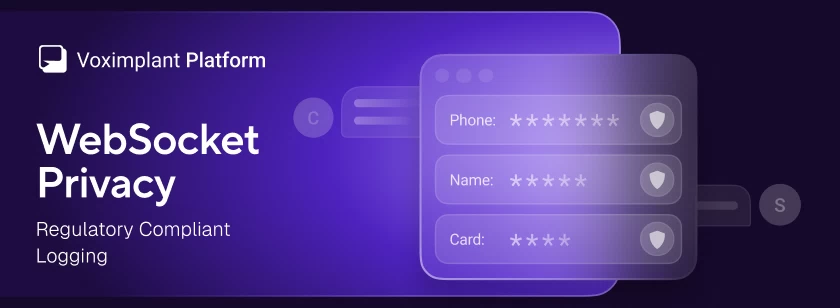
Voximplant has added a WebSocket privacy option that redacts message payloads from logs across all WebSocket-based services – Voice AI connectors and external speech system – and speech control modules
Voximplant now includes a native MCP Client for VoxEngine, giving developers direct connectivity to any MCP server and full control over every tool call
Connect any OpenAI-compatible text LLM to your voice AI pipeline in VoxEngine via Chat Completions or Responses API. Set baseUrl to any provider or your own deployment, including EU endpoints for data residency
Voximplant now includes a native Deepgram module that connects any Voximplant call to Deepgram’s Voice Agent API for real-time, speech‑to‑speech conversations. You can stream audio from phone numbers, SIP trunks, WhatsApp, or WebRTC into Deepgram’s unified agent environment—combining STT, LLM reasoning, and TTS—and play responses via Voximplant’s serverless runtime with minimal latency.
Use Realtime API in VoxEngine to build speech-to-speech voice AI with data residency control. Set baseUrl to any OpenAI Realtime-compatible endpoint, including Azure EU deployments, and control where call audio is processed




 2020-06-02
 66806
66806