




Voximplant at APIdays Amsterdam, June 18 & 19
Company speaking plan and Alexey Aylarov invitation
 2019-06-10
 174007
Company speaking plan and Alexey Aylarov invitation
2019-06-10174007

Connect any Voximplant call to ElevenLabs Conversational AI agents
2025-06-0930301
Connect any OpenAI-compatible text LLM to your voice AI pipeline in VoxEngine via Chat Completions or Responses API. Set baseUrl to any provider or your own deployment, including EU endpoints for data residency
2026-07-224848
Voximplant has new realtime speech generation for voice AI from Inworld, our latest Voice AI text-to-speech (TTS) partner. Together, we combine state-of-the-art TTS with carrier-grade connectivity so you can build voice agents that sound like your brand, not a generic robot.
2025-12-0818473
Voximplant now lets developers build full-cascade voice AI pipelines in VoxEngine without sacrificing turn-taking quality.
2026-03-267175
Voximplant AI Agent Skills let your coding agent build and ship voice applications without switching tools
2026-06-113890
Voximplant has added Secrets, a dedicated credential store for API keys, tokens, and other sensitive values that VoxEngine scenarios need at runtime
2026-04-274572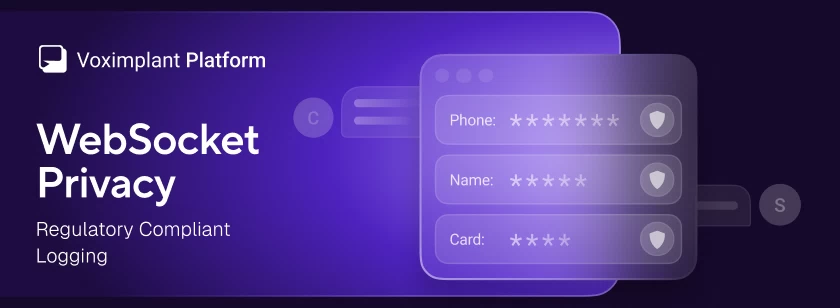
Voximplant has added a WebSocket privacy option that redacts message payloads from logs across all WebSocket-based services – Voice AI connectors and external speech system – and speech control modules
2026-04-234533
Voximplant now includes a native Cartesia Line / Agents connector that connects any Voximplant call to a Cartesia Line voice agent for real-time, speech-to-speech conversations—over PSTN, SIP, WebRTC, or WhatsApp Business Calling—without building custom media gateways or WebSocket streaming infrastructure.
2026-02-1110741