


Mobile Text Alerts for Business
To deliver customers text alerts, businesses use communications channels such as SMS and push notifications. In this article, we explain how to use text alerts.
 2020-09-29
 171755
To deliver customers text alerts, businesses use communications channels such as SMS and push notifications. In this article, we explain how to use text alerts.
2020-09-29171755
HTTP API is now available to implement scenarios which don't require client applications.
2013-10-02175352

Learn how a Voice AI Orchestration Platform connects LLMs, STT/TTS, turn‑taking, and telephony (PSTN, SIP, WebRTC) to build reliable real‑time voice agents. See benefits, architecture, and how Voximplant helps.
2025-10-2717104
Voximplant now includes a native MCP Client for VoxEngine, giving developers direct connectivity to any MCP server and full control over every tool call
2026-06-039503
Voximplant now includes a native Cartesia module for streaming, low-latency text-to-speech (TTS). You can use a single VoxEngine API to synthesize speech in real time, connect it to any call (PSTN, SIP, WebRTC, WhatsApp) and control playback from a Large Language Model (LLM) or other source, all inside VoxEngine.
2025-11-1817976
Voximplant AI Agent Skills let your coding agent build and ship voice applications without switching tools
2026-06-119278
Voximplant now includes a native Cartesia Line / Agents connector that connects any Voximplant call to a Cartesia Line voice agent for real-time, speech-to-speech conversations—over PSTN, SIP, WebRTC, or WhatsApp Business Calling—without building custom media gateways or WebSocket streaming infrastructure.
2026-02-1116076
How Jev and other decision models help LLM voice bots with topic routing, turn detection, barge-in, form filling, action checks and model choice.
2026-10-15816
Voximplant has added Secrets, a dedicated credential store for API keys, tokens, and other sensitive values that VoxEngine scenarios need at runtime
2026-04-279747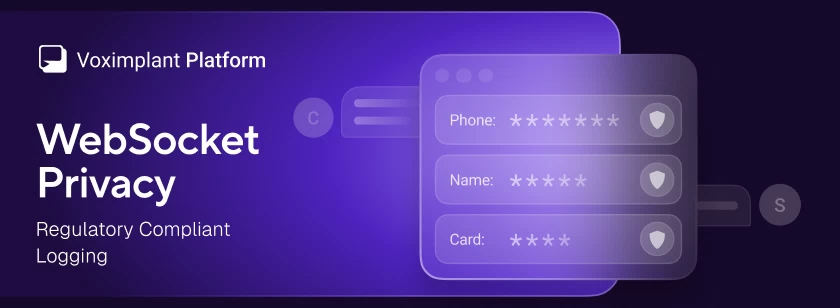
Voximplant has added a WebSocket privacy option that redacts message payloads from logs across all WebSocket-based services – Voice AI connectors and external speech system – and speech control modules
2026-04-239647