



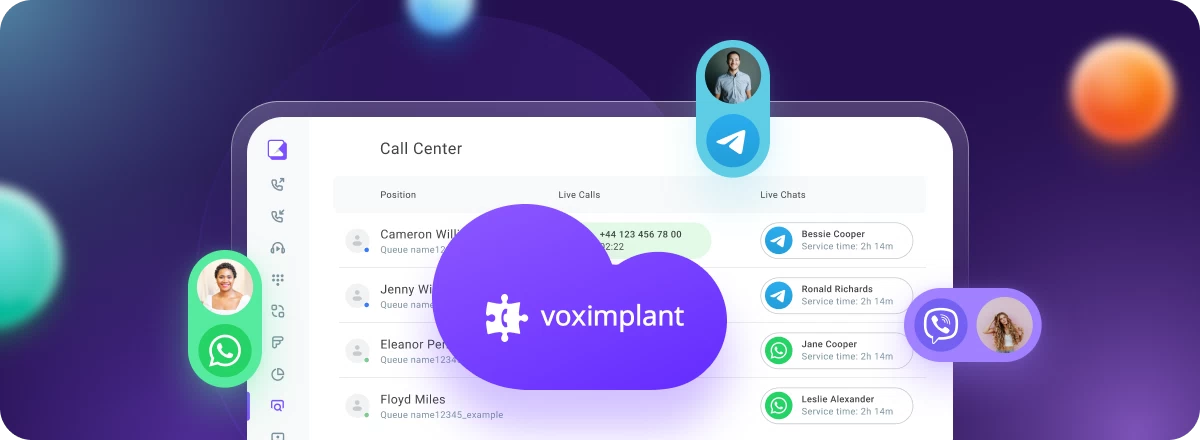
Tips for improving your customer communications with omnichannel technology
Voximplant shares tips for improving your customer communications with omnichannel technology
 2022-08-30
 134465
Voximplant shares tips for improving your customer communications with omnichannel technology
2022-08-30134465

Today Ultravox announced they are directly integrating Voximplant into their platform to provide SIP capabilities. The integration builds on Voximplant’s deep telephony and Voice AI tooling
2025-10-2912684
Voximplant AI Agent Skills let your coding agent build and ship voice applications without switching tools
2026-06-115948
Voximplant has added Secrets, a dedicated credential store for API keys, tokens, and other sensitive values that VoxEngine scenarios need at runtime
2026-04-276560
Voximplant now includes a native Deepgram module that connects any Voximplant call to Deepgram’s Voice Agent API for real-time, speech‑to‑speech conversations. You can stream audio from phone numbers, SIP trunks, WhatsApp, or WebRTC into Deepgram’s unified agent environment—combining STT, LLM reasoning, and TTS—and play responses via Voximplant’s serverless runtime with minimal latency.
2025-12-1736040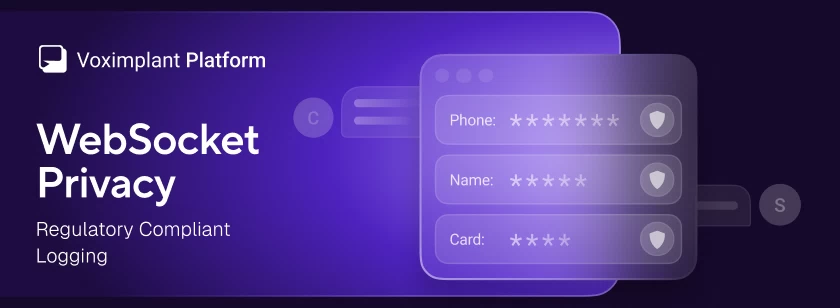
Voximplant has added a WebSocket privacy option that redacts message payloads from logs across all WebSocket-based services – Voice AI connectors and external speech system – and speech control modules
2026-04-236504
How Jev and other decision models help LLM voice bots with topic routing, turn detection, barge-in, form filling, action checks and model choice.
2026-10-1595
Voximplant now lets developers build full-cascade voice AI pipelines in VoxEngine without sacrificing turn-taking quality.
2026-03-2610131
Voximplant now includes a native Cartesia Line / Agents connector that connects any Voximplant call to a Cartesia Line voice agent for real-time, speech-to-speech conversations—over PSTN, SIP, WebRTC, or WhatsApp Business Calling—without building custom media gateways or WebSocket streaming infrastructure.
2026-02-1112797