


Voice AI pipeline touches more infrastructure than it might seem. The call comes in through telephony → Audio gets transcribed → A language model generates a response → Text-to-speech converts it back to audio.
Each step is a potential data transfer and for clients with data localization requirements, each step needs an answer.
This is the third post in a series on building compliant voice AI on Voximplant. The first two covered the LLM layer specifically: text-based LLMs through Chat Completions and Responses API, and speech-to-speech through Realtime API. Now let’s have a look at the full picture.
What Voximplant covers
Voximplant's role is the telephony backbone and orchestration layer. For accounts configured with EU data residency, media processing and data storage stay within EU-based infrastructure.
On the documentation side Voximplant maintains:
- A Data Processing Agreement with Standard Contractual Clauses
- Active EU-US Data Privacy Framework certification
- A public sub-processor list
These are the documents your clients will ask for before signing. Want to know if Voximplant fits your compliance requirements? Contact us.
How data moves through the stack
The diagram below shows the full data flow in a Voximplant-based voice AI pipeline.
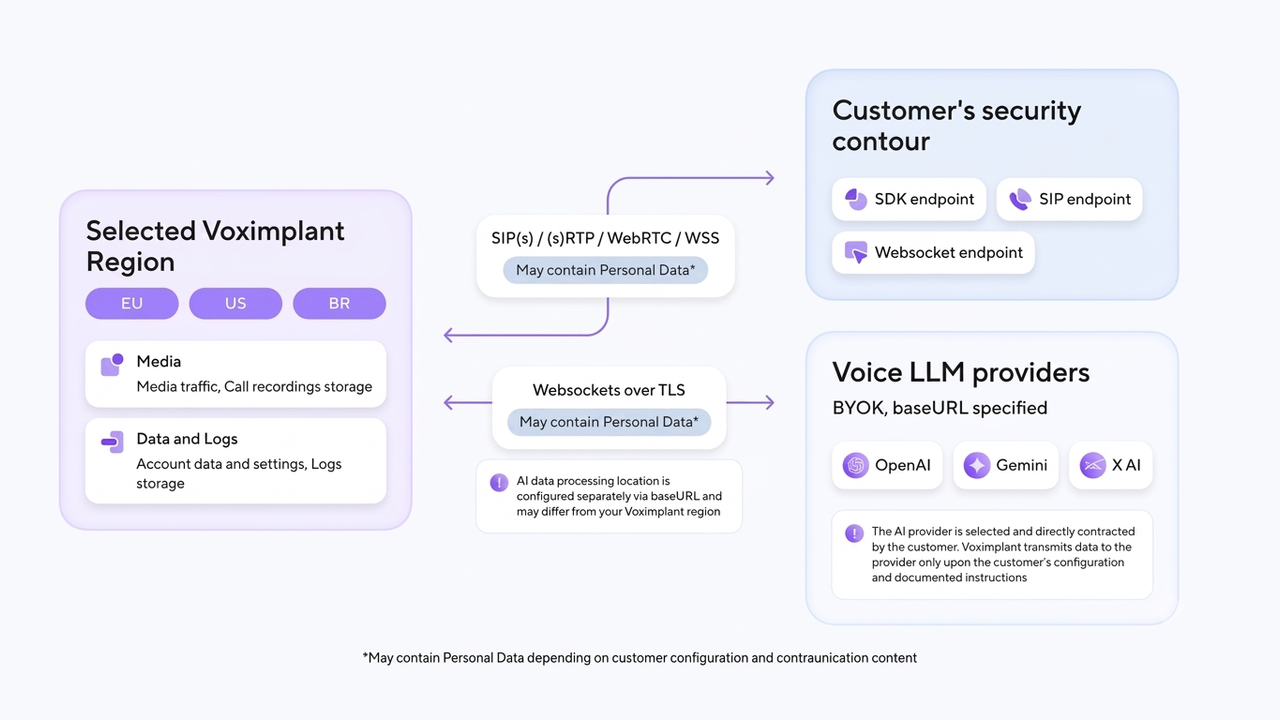
Voximplant handles the telephony layer. Account data, call recordings, and logs are stored within the region you select when creating your account. Media traffic is processed within that region by default. Though for incoming calls, processing may happen in the region where the call originates unless the account is strictly assigned to a specific region through support. Data flows between your application and Voximplant over encrypted channels: SIP(S)/SRTP, WebRTC over SRTP, and WebSocket over TLS.
The LLM layer is separate. As the diagram notes: the AI provider's data processing and storage location may differ from your selected Voximplant region. The provider is selected and contracted directly by you. Voximplant transmits data to the provider only upon your configuration and documented instructions.
The LLM layer: your choice, your configuration
This is where baseUrl comes crucial. Whether you're using Chat Completions, Responses API, or Realtime API, the endpoint you specify is where that data goes. For EU data residency at the LLM layer, you need a provider with EU-based endpoints. It’s important to verify that the specific endpoint you're using actually processes data in the EU, not just routes through it.
The rest of the stack
In a full-cascade pipeline, STT and TTS are independent components. The same principle applies to each: EU residency is not a default, it requires explicit configuration and verification with each provider.
Before going to production, confirm from each provider in your stack:
- Where data is processed and stored
- Whether EU-specific endpoints are available and what they actually cover
- Data retention and logging policies
- Compliance documentation: DPA, sub-processor list, breach notification terms
What sovereignty means in practice
Running a sovereign voice AI stack doesn't mean every byte stays in one building. It means you know where each component processes data, you have reviewed the contractual and processing terms for each provider in your stack, and you can answer your clients' questions with specifics.
The architecture to support that is available on Voximplant. The work is in configuring each layer correctly and verifying each provider's documentation before you go live.
Legal Disclaimer: This material is provided for informational purposes only and does not constitute legal advice. Compliance with applicable data protection laws depends on your specific implementation, configuration, and data processing activities. For guidance on your particular use case, please consult your legal counsel.
Resources
Text-based LLMs and data residency
Realtime API and data residency
BYO LLM documentation
Security and privacy overview
Sign up for Voximplant